


Coating Adhesion & Stamping Performance: Buyer’s Guide for Rubber-Coated Steel C
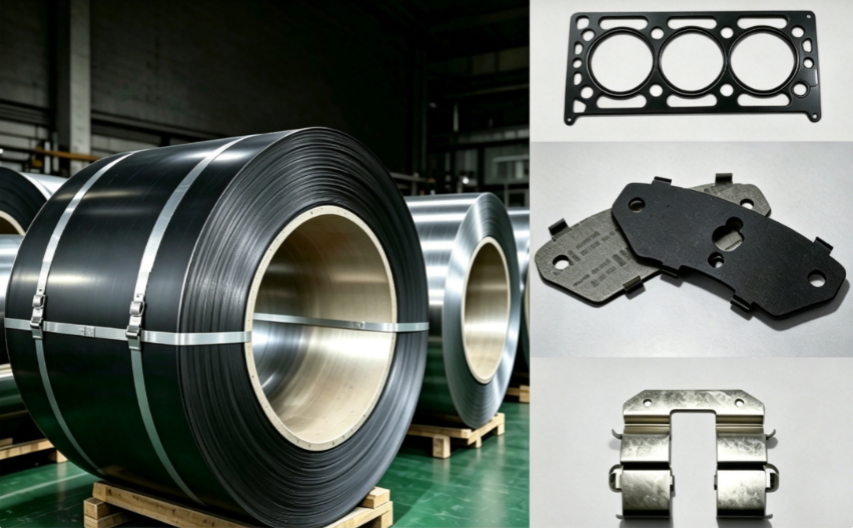
Figure: Rubber-coated steel coil (left) and stamped components – gaskets, brake shims and hardware kits (right)
When rubber-coated steel coil fails during stamping, the problem often traces back to one root cause: insufficient coating adhesion. Edge chipping, bending delamination, blanking peeling, and uneven stamped surfaces are all signs that the rubber-to-metal bond cannot withstand the mechanical stresses of forming. For buyers and engineers, understanding how to evaluate adhesion—before the coil reaches the press—is critical to avoiding scrap, downtime, and field failures.
This guide focuses on the practical side of adhesion: how it degrades during stamping, which test methods apply, how to test incoming material, and why higher adhesion is not always better.
Why Coating Adhesion Degrades During Stamping
Adhesion is not a fixed property. It changes under the mechanical forces of stamping.
Substrate surface roughening – As the steel substrate undergoes plastic strain, its surface topography changes. This can alter the effective bonding area and, in some cases, weaken the mechanical interlock between rubber and metal.
Interfacial stress accumulation – Deep drawing, bending, and blanking impose shear and tensile stresses at the coating-substrate interface. When local stress exceeds the adhesive bond strength, delamination begins.
Adhesive vs. cohesive failure – Not all failures are equal. Adhesive failure means the rubber separates cleanly from the steel surface—usually a sign of poor initial bonding. Cohesive failure means the rubber itself tears while the bond remains intact—typically indicating a stronger interface. Buyers should request failure mode data, not just strength numbers.
Industry Test Standards for Adhesion Evaluation
Several international standards provide a framework for measuring and comparing adhesion. These are common references in rubber-to-metal bonding:
- ASTM D429 / ISO 813 – Standard test methods for rubber-to-metal bond strength.
- ASTM D3359 / ISO 2409 – Cross-cut tape test for quick screening.
- ASTM D7093 – Biaxial tensile dome test combined with tape test, for evaluating adhesion after simulated forming.
Our production testing is based on internationally recognized methods—including relevant ASTM and ISO standards—and further refined into an internal control standard, Q/MFKJ B801-2026, specifically tailored to stamping applications. The following test data is from a recent batch of NBR-coated stainless steel coil (LOT NO: 260808001):
Test Item | Test Condition | Result |
Bond force | RT | Above level 2 |
Erichsen cupping | 400 μm | No cracking |
Bending performance | 5 MPa die pressure | No cracking or peeling |
T-PULL test | 25 mm × 50 mm, 50 mm/min | ≥ 2 KN |
Total thickness | — | 0.504 mm (base metal 0.402 mm, coating 0.102 mm) |
Salt spray test | 35°C × 72h | Edge erosion ≤ 2 mm |
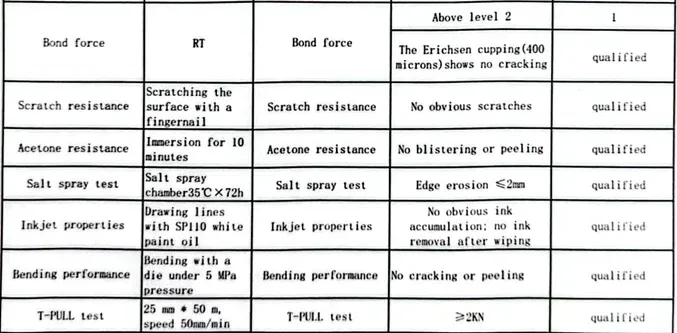
Adhesion and stamping test report excerpt for rubber coated steel coil – bond force, Erichsen cupping, bending, T-peel and salt spray
These results confirm that the coil meets the requirements for stamping applications. Buyers can request similar test reports for each batch.
Four Common Stamping Defects Linked to Adhesion
When adhesion is inadequate, four defects appear repeatedly:
Note: When these defects appear, first rule out equipment and process factors such as die edge wear, improper clearance, and stamping speed parameters before concluding that the issue is material adhesion.
1. Edge Chipping
The rubber coating fractures and chips away at the trimmed edge. This typically indicates insufficient toughness in the surface rubber layer or a bond that cannot absorb the shear stress of trimming. A minimum peel force is required to resist edge chipping; below that threshold, the coating fails locally.
2. Bending Delamination
During bending, the coating on the outside radius is stretched while the inside radius is compressed. If adhesion is too low, the rubber separates from the steel at the bend. The minimum bend radius a coated coil can withstand depends on the combination of coating thickness, rubber hardness, and bond strength. Our bending test at 5 MPa die pressure shows no cracking or peeling, confirming suitability for typical forming operations.
3. Blanking Peeling
In blanking, the punch drives through the material, creating high shear stress at the cut edge. If the bond strength is lower than the shear stress, the coating peels away from the substrate. This defect often appears as a clean separation along the cut line.
4. Stamping Uneven Surface
Uneven surfaces after stamping usually point to two combined issues: inconsistent coating thickness and uneven adhesion across the coil. Our coating thickness tolerance is controlled within ±0.01 mm, and adhesion uniformity is verified through batch testing.
Incoming Material Inspection: How to Test Before Mass Production
Buyers do not need a full laboratory to catch adhesion problems early. Three simple checks can be performed on incoming coil:
Tape Test (ASTM D3359 / ISO 2409)
- Clean the surface.
- Make a cross-hatch pattern with a sharp blade.
- Press adhesive tape firmly over the cut area.
- Pull the tape at a 45° angle.
- Pass: No coating removed, or only small flakes at intersections.
Fail: Coating peels away along the cuts.
Bend Test
- Bend a small strip of coated steel around a mandrel or a known radius.
- Inspect the outside of the bend.
- Pass: No cracking, no delamination.
Fail: Rubber separates from steel or cracks visibly.
Small-Batch Trial Stamping
- Run 50–100 pieces using the actual production die.
- Inspect for edge chipping, delamination, and surface defects.
If defects appear within the first few strokes, the coil is not suitable for that die.
Incoming Warning Signs
- Coating thickness variation beyond ±10% across the coil width.
- Adhesion test results varying by more than 20% between batches.
Visible surface irregularities or hard spots.
Adhesion Is Not “The Higher, The Better”
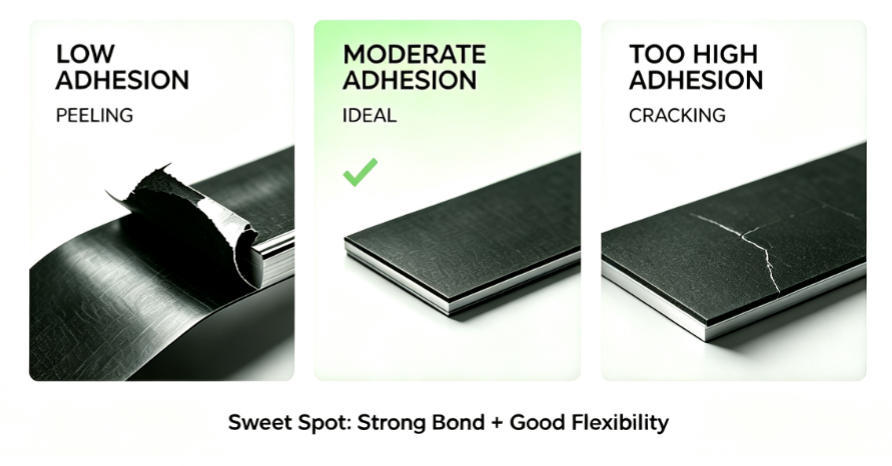
Figure: Adhesion level vs. failure mode – low adhesion peeling, moderate ideal, high adhesion cracking
A common misconception among buyers is that maximum adhesion is always best—some even specify the highest possible adhesion value when requesting quotes. In practice, adhesion must be balanced with flexibility.
- High adhesion, but too rigid – When adhesion is extremely high, formulators often achieve it by increasing rubber hardness or crosslink density. This makes the rubber stiffer and more brittle. Under bending or deep drawing, the coating may crack rather than stretch.
- Moderate adhesion – The optimal range for most stamping applications. The bond is strong enough to resist peeling and shear, while the rubber remains flexible enough to accommodate bending and forming without cracking.
- Low adhesion – The bond fails under normal stamping stresses, leading to chipping, peeling, and delamination.
The right adhesion level is the one that matches your forming process: tight bend radii and deep draws need higher adhesion without excessive brittleness; simple blanking may tolerate lower adhesion.
Frequently Asked Questions
Q1: What adhesion test should I request from my coil supplier?
Ask for test data covering bond strength, T-peel, bending, and Erichsen cupping. Our test reports cover these items, based on methods aligned with ASTM/ISO and our internal standard Q/MFKJ B801-2026, and are available for each batch.
Q2: Is a cohesive failure always better than an adhesive failure?
Generally yes. Cohesive failure means the rubber itself breaks while the bond holds—indicating the interface is stronger than the rubber. Adhesive failure means the bond is the weakest link, which is a warning sign for stamping.
Q3: Can I use the same coil for different stamping dies?
Not necessarily. Adhesion requirements depend on the stress imposed by each die. A coil that performs well in a simple blanking operation may fail in a deep drawing operation. Deep drawing and tight bend radii are high-stress conditions that demand the highest adhesion and coating flexibility. Always validate with a small trial run on the actual die.
Q4: How do I know if adhesion varies across the coil?
Ask your supplier for adhesion uniformity data—edge-to-center and start-to-end. Our batch records include this information. If not available, perform tape tests at multiple locations on a sample strip.
Get Technical Support on Adhesion and Stamping
Need help evaluating whether a rubber-coated steel coil meets your stamping requirements? Our technical team can provide adhesion test data, forming validation support, and material selection guidance.
Contact our technical team for material consultation and sample support.
📩 Email: ryleezh@chinanewmaterialtech.com
📞 Tel: +86-531-80993487
📱 Mobile: +86-152-5416-7359
🌐 Website: https://www.chinanewmaterialtech.com/
For our full certifications and quality documentation, please refer to our earlier article.
related news
-

June 12-15, 2025 Automechanika Istanbul
Jun 19,2025
-
PTFE-Coated Brake Pad Abutment: Key Advantages & Industry Trends
May 28,2026
-

Beautiful scenery of Istanbul
Jul 25,2025
KNOW MORE ABOUT US
Please enter your detailed information, and we will contact you later to provide a free quotation.
Want high quality coated steel material?
Tell us about your project so we can help you find the solution that fits your needs!

Fully automatic RCM Production Line in China
Fully automatic stamping factory line in China


quick link
contact
-
+86-531-80993487

-
+86-152-5416-7359

-
ryleezh@chinanewmaterialtech.com

-
High-Tech Zone Qisheng Square 6-708, Jinan, Shandong, China

Copyright©Jinan Sunrise New Material Technology Co. LTD